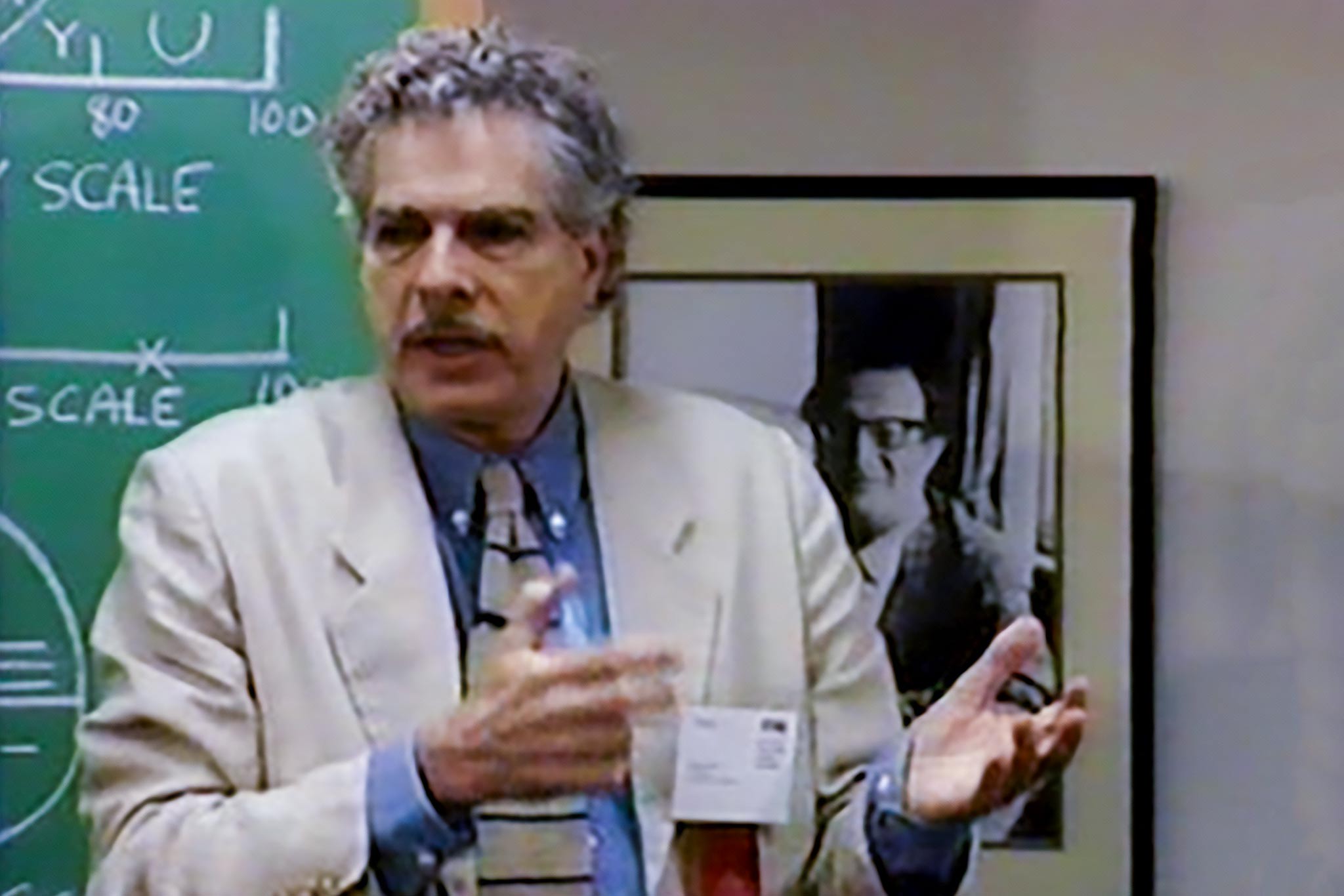
Stephen Karpman provided exclusive contributions to this special edition of The Script honoring Eric Berne, offering a rare glimpse into the formative years of transactional analysis. In an interview, Karpman shared personal memories of the original San Francisco seminars, where Berne’s rigorous scientific approach often gave way to vibrant, bohemian social gatherings.
The editorial team has edited Karpman’s recollections for length and clarity to preserve the authentic voice of one of the field’s most significant figures. Each entry serves as a time capsule of the 1960s "rebel San Francisco" era.
Pamela/Sgarbe: How did you meet Eric Berne?
Karpman: I was an assistant clinical professor at the Langley Porter Psychiatric Institute at the University of California, San Francisco. I was supervising group therapy and psychiatric residents, including Jack Dusay. Jack was already attending Berne’s seminar and invited me.
Pamela/Sgarbe: What was Berne like as a person?
Karpman: Let’s organize it the way he would. In his "Parent" ego state, he was warm and caring. He was a doctor’s doctor and ran a tight ship based on information.
In his "Adult," he looked like a genius from another planet. To get answers to questions or cases, he’d "think Martian," taking the point of view of someone brand new to Earth. Doing so, he modeled how we could free ourselves from usual ways of thinking.
In his "Child," he was playful. At the end of every seminar, we would have Child ego state time, where he’d organize fun and games.
Pamela/Sgarbe: What do you think he’d like to be remembered for?
Karpman: Especially how he ran the seminar. If we were pastiming (idle chatting), he’d say, "OK, let’s get back to work." Or, "Don’t say anything you can’t diagram." Also, his leadership. He led by example and inspired his followers to go forth and multiply to expand transactional analysis.
Pamela/Sgarbe: What exactly were the TA 202 sessions, and what was their primary purpose?
Karpman: Berne conducted these advanced theory-making sessions weekly at his home in San Francisco, and I attended every Tuesday for five years. We were not there to learn to be therapists; he trained us to brainstorm and use Occam's razor of scientific parsimony.
Everything had to be shaved down to its core and put in layman's language. History proved this approach right, as most of our eminent members invented their own major theories, like Claude Steiner's script matrix or my drama triangle.
Pamela/Sgarbe: What were some of the basic rules or prohibitions during these Tuesday meetings?
Karpman: The first rule was avoiding idle conversation. If we drifted, Berne would say, "Hey, gang, we're in danger of having an interesting evening. Let's get some work done instead."
Furthermore, psychoanalytic words were banned. We were building an evidence-based science of measurable human behavior — the opposite of the prevailing Freudian system. We could only talk about reality: what we could measure or prove with a photograph or tape recorder. No alcohol or eating was permitted.
To give you an idea of the strictness, I was once kicked out for a week for using the word "dependency" because it belonged to the forbidden Freudian vocabulary and I couldn't diagram it. Similarly, if someone declared something vague like "love is everywhere," Berne would say, "Go to the blackboard and diagram that," or he'd kick them out.
Pamela/Sgarbe: As program chairman, how did you and Berne structure the presentations?
Karpman: I met with presenters beforehand to help tighten up their presentations. During the session, the presenter had to write an unanswered theory question on the blackboard. The audience would offer solutions, making us equal to the presenter.
The format started with five minutes of spontaneous contributions, like a quick book review, to get it out of the way before rigorously debating new theory. Berne often read from his newest writings. Once, he read the colors of the "stamps" — blue for depression, red for anger and gray for fear. When he mentioned a "mauve" stamp, I questioned it. He replied, "I put that in there to hook the blemish players." It got a great laugh.
Every meeting ended with positive recognition, which we called "strokes."
Pamela/Sgarbe: Was it all strictly business, or was there room for socializing?
Karpman: We explicitly added a fourth rule to the seminars: Have fun. After the strict meetings, it was time for "Free Child" fun. We took field trips to the Old Spaghetti Factory, or stayed in the room to invent games and hold "jumping up and down" parties.
One evening we sat in a circle giving everyone strokes. Another time, we held an ESP mind-reading seminar, and Muriel James correctly guessed that Berne's father kept a microscope on his office windowsill. Berne even held a contest to see how many people could squeeze into his kitchen pantry, though he’d warn us with a smile, "Don't eat my breakfast of 7Up and eggs." He ran a tight ship professionally but was always looking for wit and camaraderie.
Karpman also shared these brief vignettes of his time with Berne during the 1960s:
The Rat Trap: After a seminar, Berne and several others visited my hippie artist’s apartment in Haight-Ashbury. As he was leaving, he said, "Let’s get out of this rat trap."
The Counterrevolutionary 999: I once surprised him at the beginning of a seminar by organizing a "999," where we dressed like hippies and sat on the floor with wine, cheese and bread. Berne immediately turned around, went upstairs and convinced half the group to "join me in my counterrevolutionary 999."
The Broad Jump: The president of the seminar was decided by a broad-jump contest.
CIA Intuition: A tall woman once entered the seminar who didn't seem to fit in. After asking her several pointed questions, Berne intuited that she was a CIA agent and kicked her out.
Puns and Pizza: Before I arrived at the 202 sessions, Viola Callaghan, Berne and others would go to pizza joints afterward. Berne also loved military punning contests. He once said the colonel rifled through his head and came up with a blank — a winner.
RFK Assassination: On a sad Tuesday night, we gathered to listen to the radio coverage of Robert F. Kennedy's assassination.
Professional Competition: We weren't generally competitive during the seminar, though I found Steiner to be professionally competitive with me, and Dusay was personally competitive even though we were best friends. I felt my primary role was to help others create new theories.
Travels to Hawaii: Occasionally, Berne received invitations to teach transactional analysis elsewhere. When he mentioned Hawaii, I jumped at the chance — a first for me, following in the footsteps of my psychoanalyst father, Ben Karpman, who lectured widely on criminology.
To ensure a productive and professional environment, we ask all members to adhere to the following principles:
🤝 Professional Courtesy
Engage with others respectfully. While debate is encouraged, personal attacks, aggressive language, and incivility are strictly prohibited. Focus on the topic, not the individual.
🎯 Constructive Contribution
Ensure your comments add value to the discussion. Avoid spam, off-topic remarks, or repetitive content. We prioritize quality discourse over volume.
🛡️ Safe Environment
Uphold the integrity of our community. Hate speech, discriminatory remarks, and harassment will result in immediate moderation. Help us maintain a secure space for all.





.jpg)







Lorem ipsum dolor sit amet, consectetur adipiscing elit. Suspendisse varius enim in eros elementum tristique. Duis cursus, mi quis viverra ornare, eros dolor interdum nulla, ut commodo diam libero vitae erat. Aenean faucibus nibh et justo cursus id rutrum lorem imperdiet. Nunc ut sem vitae risus tristique posuere.