On a sunny morning at the start of a long workday, I glanced at the online papers and was stopped in my tracks. The image in front of me was a drone shot of a bulldozer in Iran digging graves for the small bodies of children murdered by falling bombs as they tried to learn. In an attempt to look away from the horror of what each rectangle – 168 to be precise – would come to hold, I found myself focusing on the symmetry of the plots. Had someone carefully measured each space?
The image stayed with me as I went out for a walk later the same day. I noticed a new fence being built between two quaint, thatched-rooved cottages; each post being precisely measured and set in place. And then I thought again of the graves. A stark symbolism emerged: the two worlds we seem to straddle—one in which privilege and power protect boundaries and order; another in which organisation of power makes space for death. The words "fever dream" came to me as I walked on. A familiar knot formed in my stomach—the sense of a world unravelling while life here continues as normal. People passed cheerfully, saying good morning, a newspaper tucked under an arm. They said it to me, too. And I wondered how differently that moment might unfold if I were read differently—if I wore a hijab or fell below eye level from a wheelchair, for instance—and how that uncertainty might live in my body.
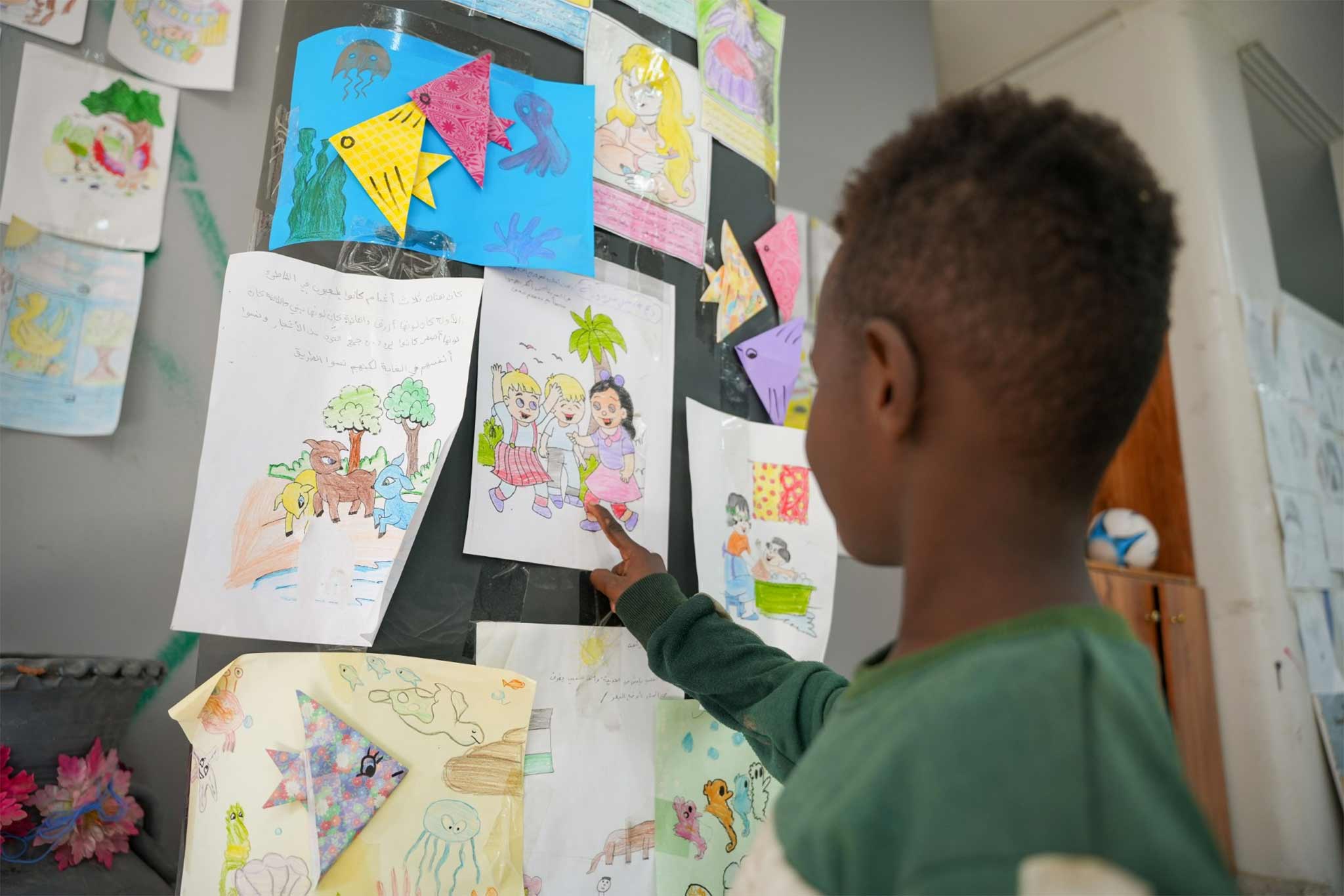
Later that day, I came across an article about a mental health organisation supporting children in Gaza. In the constant bombardment of online information, I noticed my impulse to skim and move on; I forced myself not to. One of the workers described the centre: “Many children have lost the feeling of safety and comfort that they felt when their mothers used to tell them a story before bed” (The Guardian, 2026). I paused at an image: children playing, building small worlds. Their resilience was striking. I found myself especially drawn to a collage with cardboard fish in a coloured crayon ocean. I was left wondering about the pull of an underwater world when children on land are still bombed, maimed, buried and orphaned. Since the ceasefire was announced in October 2025, Israel has struck Gaza on average 10 times a day and killed 677 people, injuring a further 1,800 (Osman, 2026, para. 3). In Lebanon, 1.1 million people have been displaced, over 1,500 killed and a further 5,000 injured in the past five weeks (Sabbagh & Christou, 2026, para. 24). As these figures roll over our screens, increasing by the day, let us never forget that each one was a person as deserving of love and life as any one of us.
We must not let our silence give fuel to the deception and mystification that allows these systems to keep fulfilling their murderous plight. Alongside writing to MPs, going on demonstrations and signing petitions, we can do work closer to home, too, even in our homes. I notice it in small, relational moments: challenging my son who at times can reserve a sharper and more exasperated tone for me and not the male members of our family. Asking what is being enacted, and why. Asking the bus driver on my way to work why the young Black student in front of me didn’t get the same cheery greeting as I did. Interrupting hectic messages on local, ‘community’ WhatsApp groups where casual misogyny and racism weave into talk about local sporting events or birthday celebrations. These systems of power and injustice are all around us and in us. The challenge in naming and centering these dynamics lies in keeping an awareness that they are also embedded in my own subjectivity and that I, too, am capable of reproducing them. These systems are not only external to me; they meander through my intrapsychic landscape and therefore call for ongoing reflection and accountability. As Brach (2026) recently said on a podcast entitled The Architecture of Silence: “What might I not be seeing that's helping to perpetuate systemic harm?” (34:02, original emphasis).
As these patterns come into view, we start to see them unfolding all around us – the process can feel disorienting—and lonely. When power is questioned, there is often a pull to align with it, where belonging can feel safer. And yet something is lost in that alignment—a sense of connection to suffering beyond our immediate lives. What we tolerate in quiet corners does not stay there; it multiplies, seeping outward, feeding larger ecosystems of harm. But small acts of refusal and disruption, when repeated across many voices, can travel.
When I feel alone, I imagine an invisible thread stretching backward—toward lives marked by movement of my ancestors through the Middle East, and the resilience that followed them. There is another thread, harder to hold, that runs through British military ancestral presence in those same landscapes. I don’t know exactly what it carries, but it makes me wonder about the silences people keep, and what has to be set aside in order to continue. Licorish’s (2025) words come to me: “I exist in a tension of contradictions” (p. 6).
It would be far more comfortable to identify only with the parts of myself that have been oppressed. Harder is also to recognise the privileged parts implicated in systems of oppression. For those of us holding mixed heritage identities, this can be a profound psychic and somatic task. How do we hold both without annihilating one? I don’t have answers. It feels challenging, never-ending and painful.
I find myself thinking more and more about the forms privilege can take. The relative safety afforded by a good enough education that buffer some of us from the ways online spaces amplify and profit from hatred directed at trans and immigrant communities, grooming the gaze away from rich powerful white men. Enough financial stability means never having to face the question of whether to skip a meal so that a child can eat.
If we look closely, many of us are held within layers of protection. “Society leads us to believe that privilege is a dirty thing. It isn’t. It’s what we do with it that counts” (Turner, 2026, 12:50).
Perhaps this is the most uncomfortable part. To what extent does our comfort sit alongside—rather than entirely separate from—the suffering of others? And if we had been more willing to examine this, individually and collectively, might things have unfolded differently? It is impossible to know. If change is possible, it may begin in the spaces closest to us. It is never too late to begin. The speaking out and challenging may result in loss, but nothing will equate to the loss of Gazan children or those Iranian mothers whose children will by now be in those tiny graves.
*
Editor’s note: The International Transactional Analysis Association (ITAA) Communications Committee and the staff of The Script wish to express their sincere gratitude to Veronika Riepina, media officer for the UK News Team at the British Red Cross, for her kind assistance in providing the photograph illustrating this article. We remain at your disposal should you require future support.
Brach, T. (2026, March 26). The architecture of silence [Audio podcast episode]. In Sounds of SAND. Science and Nonduality. https://podcasts.apple.com/gb/podcast/sounds-of-sand/id1643318607?i=1000757538827
Licorish, D. (2025). Beyond ‘the door of no return’: Beingness and (be)longing as a Black therapist. Psychotherapy & Politics International, 23(4), 1–13. https://doi.org/10.24135/ppi.v23i4.04
Osman, H. (2026, March 23). Gaza ceasefire: Paramedic father killed as civilian death toll rises. The Guardian. https://www.theguardian.com/global-development/2026/mar/23/gaza-ceasefire-paramedic-father-killed-civilian-death-toll
Sabbagh, D., & Christou, W. (2026, April 9). At least 254 killed after Israel hits Lebanon with massive wave of air strikes. The Guardian. https://www.theguardian.com/world/2026/apr/08/israel-operations-in-lebanon-to-continue-despite-trump-ceasefire-iran-pakistan-hezbollah
The Guardian. (2026, March 5). Exercise and freedom: Inside a children’s mental health centre in Gaza. https://www.theguardian.com/world/gallery/2026/mar/05/childrens-mental-health-centre-gaza
Turner, D. (2026, March 28). Privilege and otherness: Encountering the unconscious other in ourselves [Online presentation]. Eventbrite. https://www.eventbrite.com/x/privilege-and-otherness-encountering-the-unconscious-other-in-ourselves
To ensure a productive and professional environment, we ask all members to adhere to the following principles:
🤝 Professional Courtesy
Engage with others respectfully. While debate is encouraged, personal attacks, aggressive language, and incivility are strictly prohibited. Focus on the topic, not the individual.
🎯 Constructive Contribution
Ensure your comments add value to the discussion. Avoid spam, off-topic remarks, or repetitive content. We prioritize quality discourse over volume.
🛡️ Safe Environment
Uphold the integrity of our community. Hate speech, discriminatory remarks, and harassment will result in immediate moderation. Help us maintain a secure space for all.



.jpg)


.jpg)







Lorem ipsum dolor sit amet, consectetur adipiscing elit. Suspendisse varius enim in eros elementum tristique. Duis cursus, mi quis viverra ornare, eros dolor interdum nulla, ut commodo diam libero vitae erat. Aenean faucibus nibh et justo cursus id rutrum lorem imperdiet. Nunc ut sem vitae risus tristique posuere.