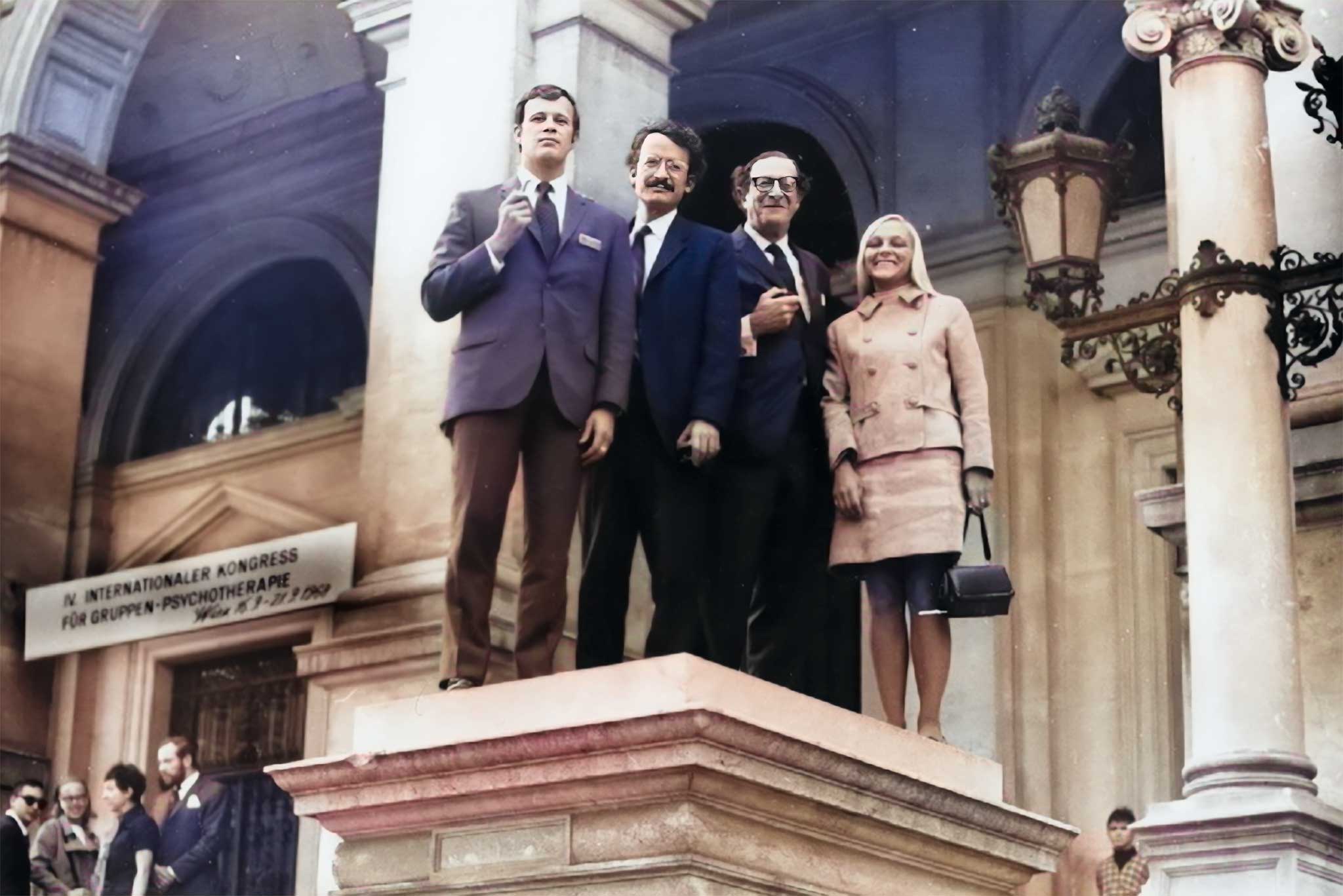
Dear International Transactional Analysis Association (ITAA):
I began my ITAA membership on April 1, 1975, and continued seamlessly for 51 consecutive years. I am so proud of my membership record and support of the ITAA and the North American Transactional Analysis Association (NATAA).
I have admired the ITAA presidential leadership from Dr. John “Jack” Dusay (1974-75) through current president Marguerite Sacco (2025-26). They are all dedicated to the progress of transactional analysis (TA) via the structure, continuing emphasis on clinical acumen and global outreach of the ITAA.
The reason I write and submit this letter is that, as of April 1, 2026, I am wrapping up 51 straight years as a regular member of the ITAA. I want to warmly express my love, admiration and appreciation for TA, which I started learning in September 1969 and have continued as an active learner all these years. It has been all positive. I have received lots of positive strokes, quality friendships and relationships, many enlightening professional skill development activities, memorable conferences and countless warm fuzzies!
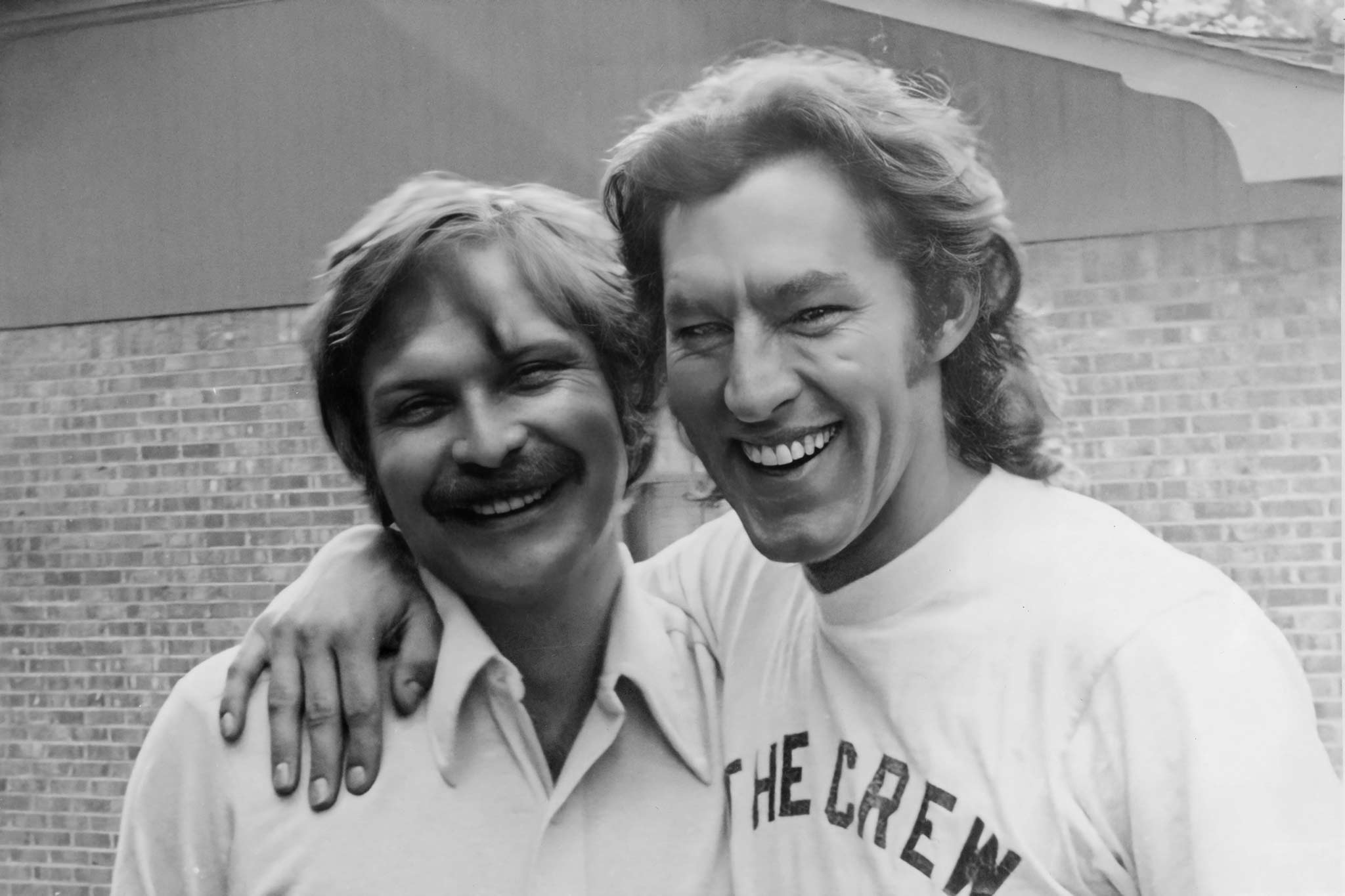
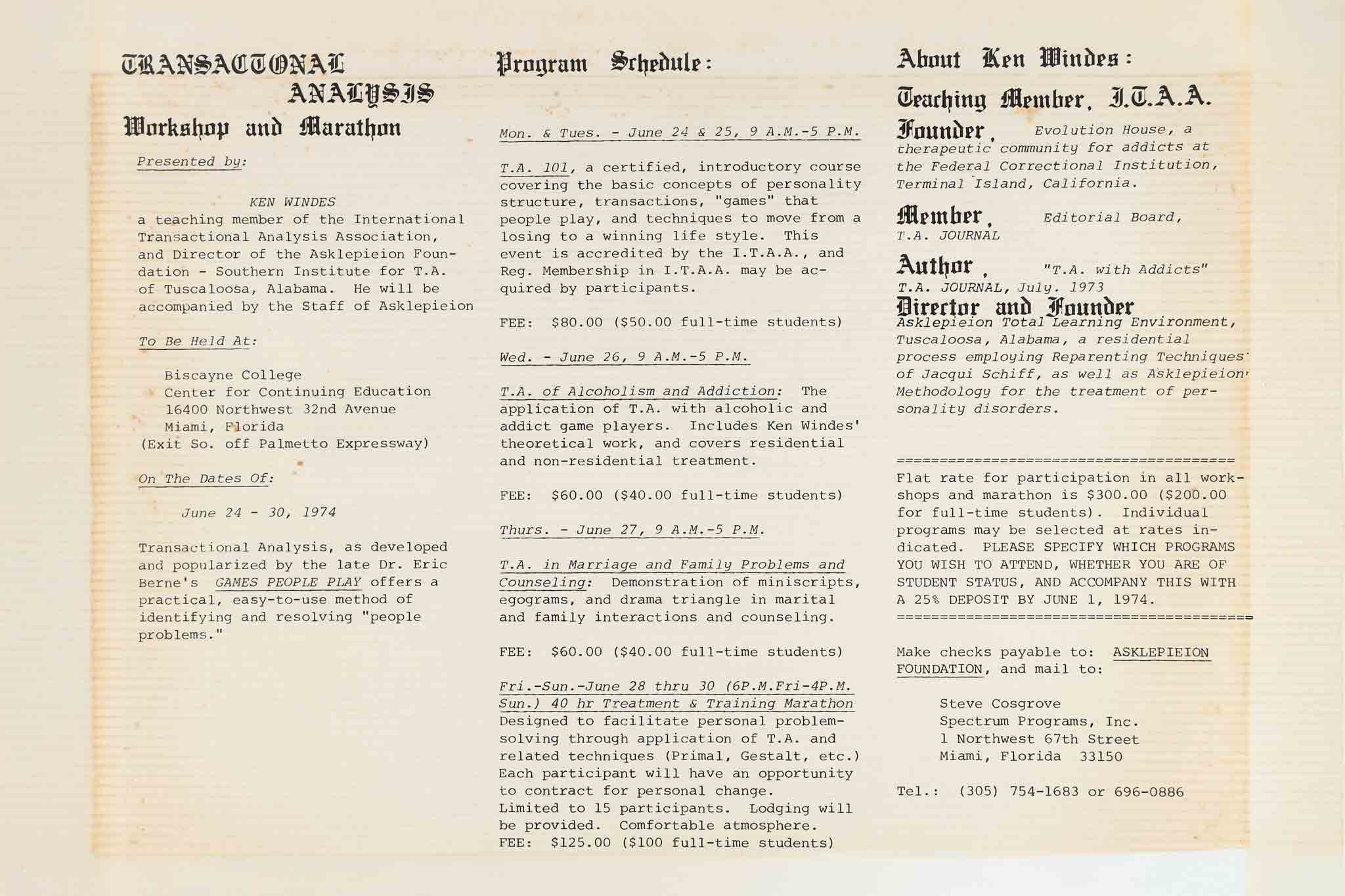
I was first introduced to TA in the Asklepieion Therapeutic Community at the Marion Federal Penitentiary (MFP) in Marion, Illinois. Alcatraz Federal Penitentiary was closed in 1963, and all the inmates were transferred to Marion, known then as the world’s most maximum-security prison. Through Dr. Martin Groder and Kenny Windes, from 1969 to 1973 and beyond, I gained valuable insight into TA.
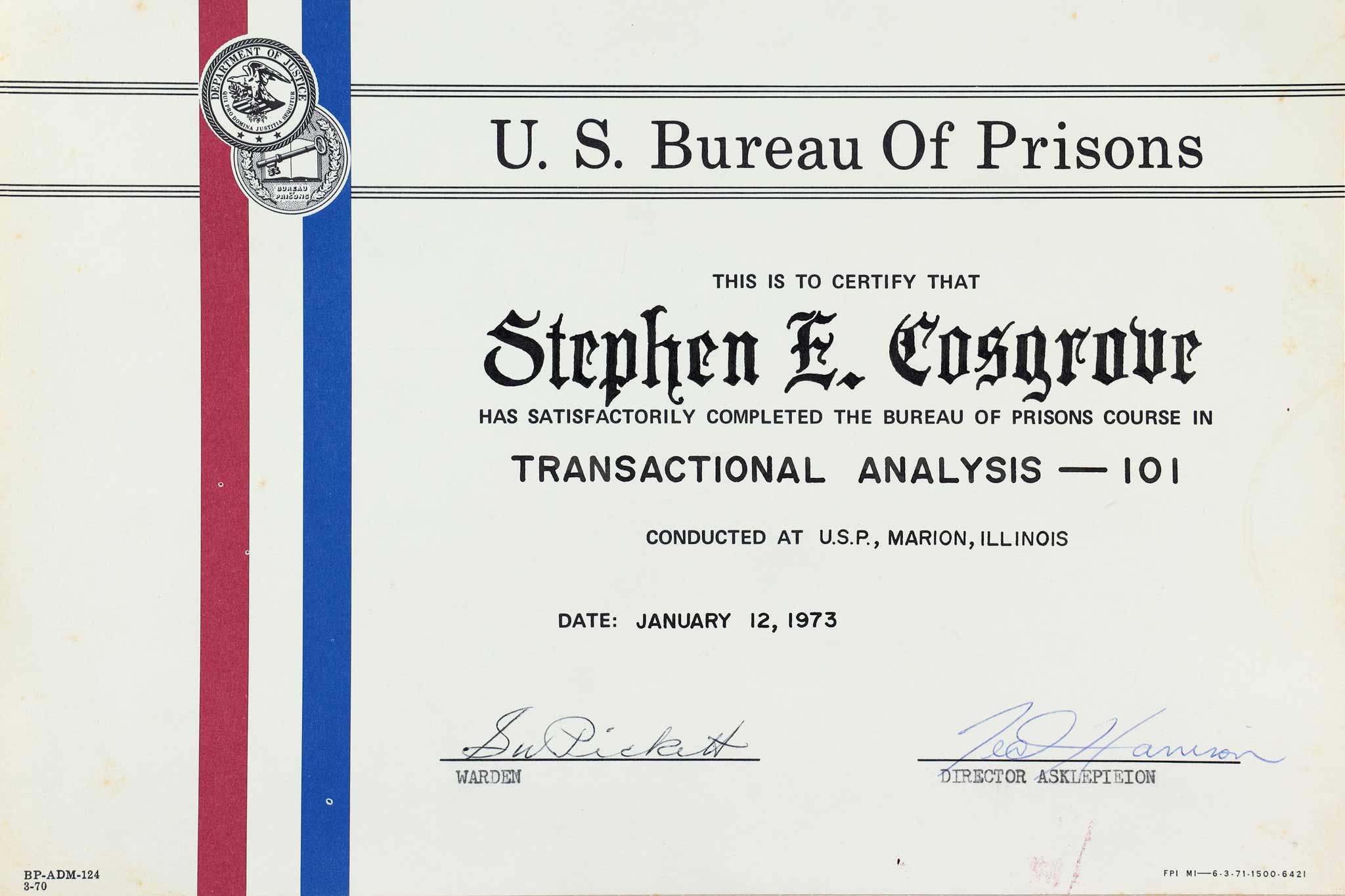
As a new graduate student in the master’s degree rehabilitation counseling program at Southern Illinois University-Carbondale, I was involved weekly as a counseling practicum student at the Asklepieion Therapeutic Community (Asklepios is Greek for “House of Cure”). I served there for four years, two months and 22 days, making two to four visits some weeks. I learned so much from these inmate-driven TA clinical experiences, often in the context of the Synanon Game. For me, this MFP time served to form the foundation to learn TA as a viable psychological tool firmly riveted for life!
Marty Groder interned in his psychiatric academic and early professional career with Dr. Eric Berne in the early days of the San Francisco Transactional Analysis Seminar. There, he was introduced to TA and mastered its concepts and applications. Marty created the Asklepieion program at the MFP, where he met “his brightest star,” as he referred to inmate Kenny Windes. Kenny was the first prison-institutionalized clinical member of the ITAA while he was still doing time. Both Marty Groder and Kenny Windes were consummate professionals, brilliant mentors and highly recognized in the TA community. They remained close lifelong friends to each other and to me until their deaths.
My first eye-opening TA conference was the Southeastern Institute Spring Conference in March 1975 in Chapel Hill, North Carolina. The institute was founded by Dr. Vann Joines, a position he has maintained all these years. I use the term “eye-opening” because this is where I met Vann and so many TA rock stars. These included Felipe Garcia, Lucy Freedman, Bob and Mary Goulding, Jonathan and Laurie Weiss, Curtis and Nancy Steele, Claude Steiner, Taibi Kahler, Fanita English, Graham Barnes, Alan Jacobs, Jacqui and Shea Schiff, Valerie Batts, Jean Maxwell, Steve Karpman, Richard Erskine, Ted Bruce, Ted and Judy Harrison, Joe Casriel, Josephine Lewis, Abe Wagner, Bill Cornell, Muriel James, Rebecca Trautman, Vince Gilpin and Steve Langton, along with so many more truly charismatic TA practitioners.
After that, I had the opportunity to attend ITAA conferences in Snowmass, Colorado; San Francisco, California; San Antonio, Texas; Raleigh-Durham, North Carolina; and Miami, Florida. Each time, I was further enlightened to the practicality and effective application of TA to every situation, workplace and professional environment. I also saw its value across all populations, cultures and ideologies.
Hence, my gratitude to the ITAA, with its key organizational purpose and role in affording the official platform for TA implementation, runs deep and will accompany me always.
I have the same regard for the USA Transactional Analysis Association (USATAA), now the NATAA. It is also centered around the principles of TA, wrapped in total OK-ness. Founded by Felipe Garcia, Lucy Freedman and others, the NATAA offers an additional professional organization for clinical and teaching credentials for TA and for ready application to issues in today’s world.
I have personally benefited from TA and its wonderful core of practitioners and leaders amid diverse learning experiences. My membership has remained that of an RM, which has served me well all these years. I have learned so much and have comfortably shared my modest proficiency of TA with others in various places and situations, often rendering complex conditions understandable.
I have incorporated TA into my personal, family and professional life in ways that have augmented the lives of others and the organizations that I continue to work with. TA has been a tremendous boost to the quality and meaning of my life!
Lastly, I have complete collections to date of the TA Bulletins and the ITAA Journals, which I have read and reread. Along with a nice library of TA articles and related books, I will one day offer these to both the NATAA and the ITAA for their respective libraries and collections.
It is with heartfelt sincerity that I wish the ITAA robust growth, solvency, organizational health and success. I hope it continues its mission to enlighten people and organizations through the profound and practical tool we know as TA. Creating unconditional OK-ness has been and will always be a hallmark of TA, the ITAA and the NATAA.
To ensure a productive and professional environment, we ask all members to adhere to the following principles:
🤝 Professional Courtesy
Engage with others respectfully. While debate is encouraged, personal attacks, aggressive language, and incivility are strictly prohibited. Focus on the topic, not the individual.
🎯 Constructive Contribution
Ensure your comments add value to the discussion. Avoid spam, off-topic remarks, or repetitive content. We prioritize quality discourse over volume.
🛡️ Safe Environment
Uphold the integrity of our community. Hate speech, discriminatory remarks, and harassment will result in immediate moderation. Help us maintain a secure space for all.






.jpg)









Lorem ipsum dolor sit amet, consectetur adipiscing elit. Suspendisse varius enim in eros elementum tristique. Duis cursus, mi quis viverra ornare, eros dolor interdum nulla, ut commodo diam libero vitae erat. Aenean faucibus nibh et justo cursus id rutrum lorem imperdiet. Nunc ut sem vitae risus tristique posuere.