Sometimes I find myself wondering how Eric Berne would look at my work today. Not at the theory, not at the structure of the session, but at the moment of meeting itself — how I sit with a child, what I notice, what I choose to do or not to do.
In his early work, Berne emphasized careful observation of behavior as the basis for understanding ego states (Berne, 1961). What has always touched me in his writing is this attention to living experience. He seemed to look at people — and especially at children — not only as carriers of symptoms, but as expressions of life in its immediacy.
In my practice, there is a girl, 12 years old, with whom I have been working for almost two years.
Her parents brought her to therapy with specific concerns: no friends, social withdrawal, refusal to turn on her camera during online classes. It sounded like behavioral problems that needed to be addressed.
But in the very first sessions, it became clear that behind these difficulties there was not a lack, but rather an excess. As if there was too much inside her — thoughts, images, interests, feelings — and it all struggled to find a place.
I did not focus directly on the “problems.” Not because they were unimportant, but because they seemed to be consequences. Instead, we began simply to be in that space together.
We drew, played, created stories, talked about books. Sometimes several processes would unfold within a single session — and I noticed how much could be held if I did not try to organize or reduce it.
Gradually, her parents began to say that changes were happening on their own. “It’s as if everything became easier,” “as if those problems were never really there.”
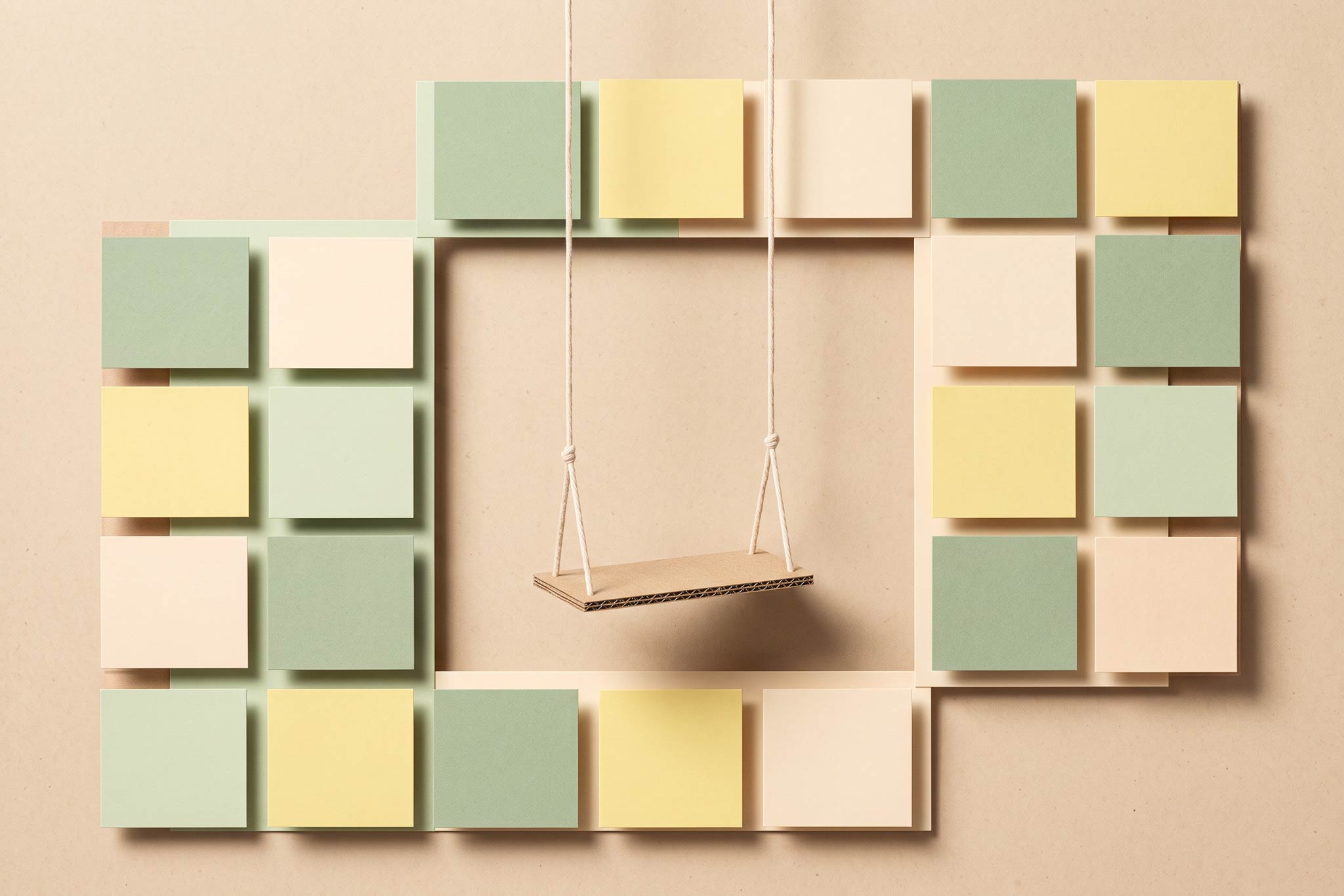
One day, she brought a calendar she had made herself.
It included days for reading, for creating, for playing, for being with family, for resting. There were even days when she could do nothing. Everything was designed as a flexible system: elements could be moved, rearranged, added, or removed.
At the center of the calendar were swings — made of cardboard and strings, three-dimensional, movable.
I asked what they meant.
She said: “It’s a place I can come to from any day, just to be a child.”
At some point, she said something else that stayed with me: “It’s so important for me to have someone I can tell this to, and for that person to just look at what I’m doing with me.”
I think Berne would understand this.
Because in that moment, something very simple and very complex happens at the same time: therapy stops being a place where something needs to be fixed, and becomes a place where someone can be seen.
Later, she told me about her plans for the summer.
Usually, she said, she wants to do too much — so much that it becomes impossible to realize. And by the end of summer, she feels that she “didn’t do anything.”
This time, she decided to do it differently.
She chose a few things that really mattered to her and placed them in the shared family calendar — so that they would be visible not only to her, but to others as well. The rest she kept, but as flexible — something that could be moved, changed, or let go.
I asked her what would happen if something didn’t work out. She paused for a moment and said: “I already know that not everything will fit. But if I do what matters most, I will manage at least something. And maybe that is already a lot.”
In that moment, I felt how much this speaks to us — to adults, to therapy, to life. And perhaps these are the children who grow up and come to us as clients. With the feeling that they are too much. With experiences that do not fit. With a desire to be seen — fully.
And then the question is not how to change them. But whether we can stay with them long enough to see.
Berne wrote about physis as an inner drive toward growth. More and more, I find myself thinking that our work is not to initiate this process, but to create the space in which it can unfold.
Sometimes — simply by staying.
And watching together.
Berne, E. (1961). Transactional analysis in psychotherapy: A systematic individual and social psychiatry. Grove Press.
To ensure a productive and professional environment, we ask all members to adhere to the following principles:
🤝 Professional Courtesy
Engage with others respectfully. While debate is encouraged, personal attacks, aggressive language, and incivility are strictly prohibited. Focus on the topic, not the individual.
🎯 Constructive Contribution
Ensure your comments add value to the discussion. Avoid spam, off-topic remarks, or repetitive content. We prioritize quality discourse over volume.
🛡️ Safe Environment
Uphold the integrity of our community. Hate speech, discriminatory remarks, and harassment will result in immediate moderation. Help us maintain a secure space for all.




.jpg)











Lorem ipsum dolor sit amet, consectetur adipiscing elit. Suspendisse varius enim in eros elementum tristique. Duis cursus, mi quis viverra ornare, eros dolor interdum nulla, ut commodo diam libero vitae erat. Aenean faucibus nibh et justo cursus id rutrum lorem imperdiet. Nunc ut sem vitae risus tristique posuere.