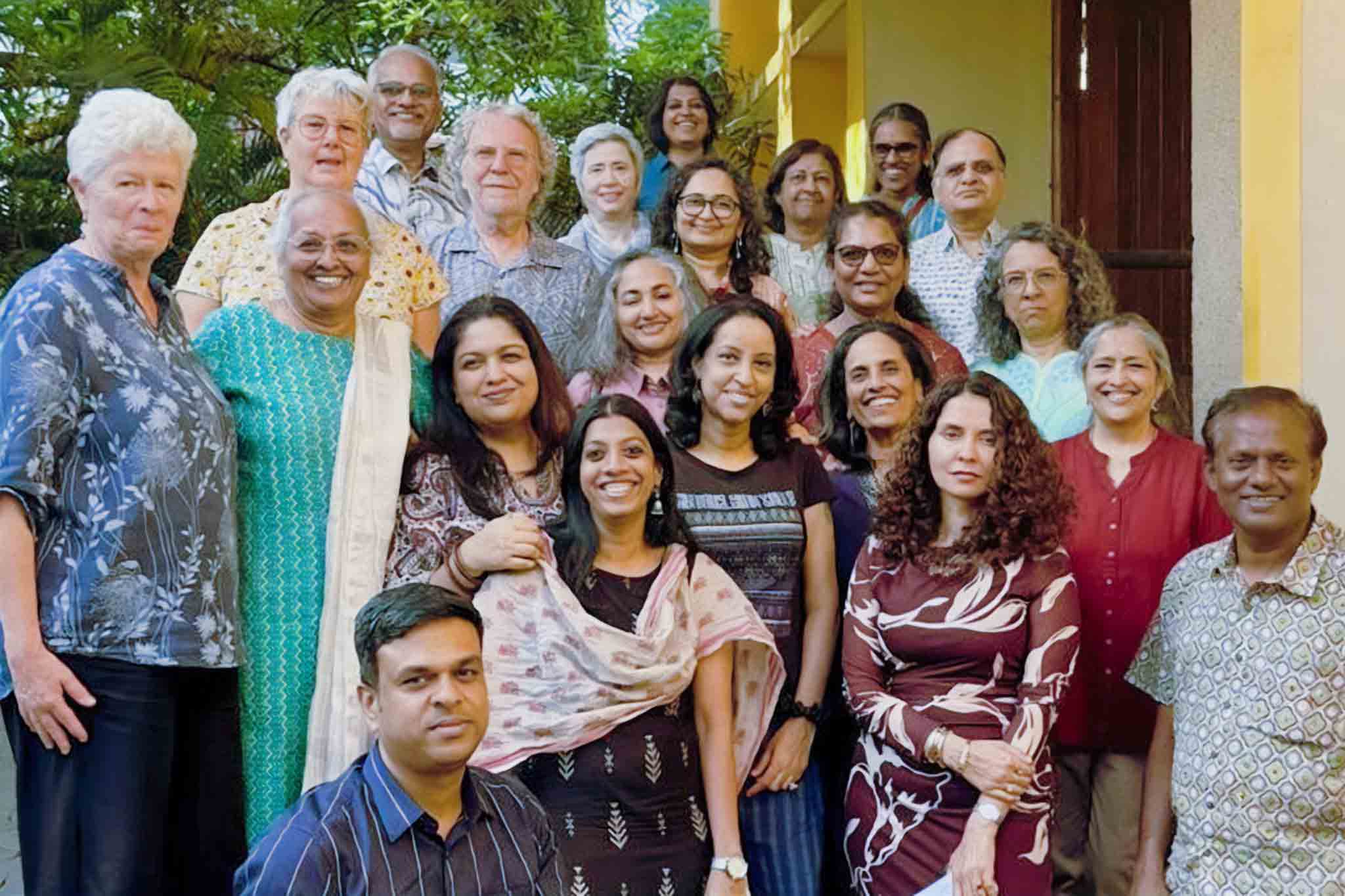
Multi-Level Learning (MLL), the South Asian Association of Transactional Analysts’ (SAATA) annual professional development event, has never been a conventional learning event. It has always been a living, experiential, and deeply relational space where themes are not discussed from a distance but encountered as lived practice.
MLL 2026 marked the 26th edition of this evolving space, and my own 10th MLL. Describing it as a living event feels only natural. Over a decade, I have witnessed MLL grow, stretch, deepen, and continually reimagine itself in thoughtful and exciting ways.
Held Jan. 10-11, 2026, the two-day event unfolded in coastal, culturally rich Mangaluru, India. Its serene presence offered a grounded and reflective backdrop for deep professional inquiry and shared learning. The event was seamlessly convened by Kala Balasubramanian, with Haseena Abdulla serving as our gracious local host.
The theme, Ethics of Power and Protection in the Context of Me, We, and the World, invited participants into an unfolding ethical inquiry. Twenty-three faculty members—Certified Transactional Analysts (CTA), Provisional Teaching and Supervising Transactional Analysts (PTSTA), and Teaching and Supervising Transactional Analysts (TSTA)—from India, the Netherlands, New Zealand, and South Africa, alongside 80 participants, engaged across six parallel learning streams.
MLL drew attention to how power operated within, how impulses were recognized, how internal authority was owned, and how responsibility can be consciously chosen with an ethical lens. As the inquiry moved into relational spaces, the focus widened: in groups, ethics revealed itself in how voice was invited, difference was held, and protection was shared. Subsequent sessions extended the ethical lens to examine how power, when normalized within systems, shaped justice, exclusion, and collective survival.
Through its layered supervisory design, MLL made visible the deep interdependence of personal, professional, and systemic ethics. Learning emerged not only from content but from how hierarchy and safety were negotiated in real time. The newest addition, the Curiosity Carnival, added a vibrant, participant-led dimension where individual agency and collective wisdom converged.
MLL is an annual event the Transactional Analysis (TA) community looks forward to, and it is the engagement of participants that keeps it vibrantly alive. Participants warmly appreciated the clear direction and rich experiential design. Alongside this appreciation, they also offered thoughtful feedback, highlighting the need for improved acoustics especially during supervisions, more time for facilitation, greater clarity within the Curiosity Carnival, and additional opportunities for informal networking. Some also expressed a wish for a longer MLL, perhaps spread across three days.
Ethical power is relational: it begins within the self, unfolds between people, and shapes the world we collectively create. MLL 2026 left me reflecting deeply on my responsibilities. The conversations challenged my frame of reference and left me sitting with the discomfort of noticing, which I recognize as learning. This was MLL 2026. The next one will be different, as it should be.
“At MLL 2026, we intentionally designed the Curiosity Carnival to shift from facilitator-led sessions to a participant-driven ecosystem. Grounded in Knowles’ principles of Adult Learning and inspired by Harrison Owen’s Open Space Technology, this design reflected a hypothesis we wished to test: that adult learners engage more fully when trusted with agency. What unfolded exceeded our expectations. Participants proposed topics, and the community selected six through a democratic process. As participants shaped their own learning journeys, the quality of engagement deepened visibly. By trusting collective intelligence, we witnessed the power of co-created inquiry.”
— Eric James (CTA-O) & Piyush Dixit (PTSTA-C)
“When I was first asked to convene MLL 2026, doubt spoke loudly. What helped me say yes was not certainty, but trust in the TA community. Every key decision emerged through dialogue. It was heartening to witness the 23 faculty members hold differences and make space for every voice. This year, something quietly radical unfolded. TSTAs also facilitated and were supervised by PTSTAs and CTAs. Hierarchy was acknowledged but did not dictate. In those moments, we did not just talk about OKness; we lived it. MLL 2026 reminded all of us that ethics is not a theory to be discussed. It is a practice we choose, moment by moment.”
— Kala Balasubramanian (PTSTA-P)
“I am very grateful for having had this opportunity to participate as staff. It was a fantastically well-organized and innovative event. The theme was power, protection, and ethics, and this was visible not only in the content but also in the process. What was particularly impactful for me was being one of three non-Indian staff members and experiencing again the assumptions and (counter)transference that brings. I embody many different minority identities myself and am quite used to being the only whitish person, or the only woman, in the room. My various experiences in India and the moving exchanges with my colleagues have kickstarted my activist roots again and gotten me to think about what I am now calling educational colonialism. Watch this space because I am planning to write more about this with my colleagues.”
— Sari van Poelje (TSTA-O, EMCC Master Coach, Drs.)
To ensure a productive and professional environment, we ask all members to adhere to the following principles:
🤝 Professional Courtesy
Engage with others respectfully. While debate is encouraged, personal attacks, aggressive language, and incivility are strictly prohibited. Focus on the topic, not the individual.
🎯 Constructive Contribution
Ensure your comments add value to the discussion. Avoid spam, off-topic remarks, or repetitive content. We prioritize quality discourse over volume.
🛡️ Safe Environment
Uphold the integrity of our community. Hate speech, discriminatory remarks, and harassment will result in immediate moderation. Help us maintain a secure space for all.





.jpg)







Lorem ipsum dolor sit amet, consectetur adipiscing elit. Suspendisse varius enim in eros elementum tristique. Duis cursus, mi quis viverra ornare, eros dolor interdum nulla, ut commodo diam libero vitae erat. Aenean faucibus nibh et justo cursus id rutrum lorem imperdiet. Nunc ut sem vitae risus tristique posuere.